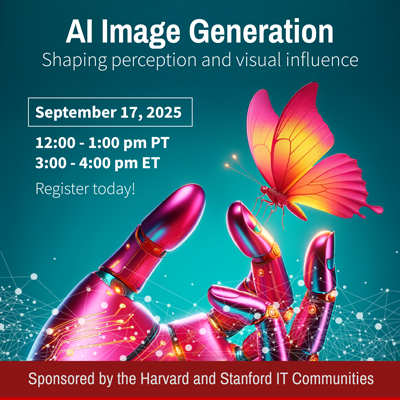
Join us for a collaborative event co-sponsored by the IT Communities at Harvard and Stanford on Wednesday, September 17, 2025 from 12:00 PM to 1:00 PM PT (3:00 PM to 4:00 PM ET). Delve into the topic of AI image generation and online platforms, where we will explore how algorithms influence visual representation in the digital age. This event will not be recorded.
Our speakers will discuss popular AI-imaging tools, present research on emerging patterns and limitations, and share insights into how these technologies shape digital content and cultural narratives. Learn how to create and use balanced AI imaging systems that better reflect the depth and complexity of all individuals.
Don't miss this opportunity to learn from experts, engage in critical conversations, and connect with colleagues across institutions. We look forward to an inspiring and thought-provoking session!
Panelists:
Dr. Douglas Guilbeault completed his PhD in Communications in the Network Dynamics Group at the University of Pennsylvania’s Annenberg School for Communication. He was an assistant professor at Berkeley's Haas School of business for four years before becoming an assistant professor at Stanford's Graduate School of Business, where he co-directs the Computational Culture Lab. Guilbeault's work harnesses and builds computationally intensive network- and language-based methods to study how concepts, norms, and organizational cultures more generally emerge and evolve. His work has appeared in a number of top journals, including Nature, The Proceedings of the National Academy of the Sciences, and Management Science, as well as in popular news outlets, such as The Atlantic, Wired, and The Harvard Business Review. He has received top research awards from The International Conference on Computational Social Science, The Cognitive Science Society, and The International Communication Association.
Nava Haghighi is a PhD candidate in human computer interaction, computer science at Stanford University, advised by Professor James Landay. Her research examines the ontological assumptions—the boundaries of what we allow ourselves to imagine—embedded in the design of sociotechnical systems, with a focus on human-centered AI. A critical technical designer, Nava develops theories and methods for surfacing ontological assumptions in current sociotechnical systems, and designs and builds systems toward expanding the presumed assumptions. She has worked as a PhD researcher at Apple with the Human-centered Machine Learning and Body-sensing Intelligence groups, as a research resident at SPACE10, and as a designer with clients such as Lexus and Tesla. She co-founded Atolla, an AI skincare company that was successfully acquired in 2021. Nava holds a dual master of science in computer science and integrated design and management from MIT, and a bachelor of architecture from California Polytechnic State University, San Luis Obispo.
As the AI Project Lead at the Bok Center’s Learning Lab, Madeleine Woods designs tools that help faculty and students engage with AI as both a medium and a method for learning. Formally trained in folklore and linguistics (Harvard University BA, Cambridge University MA), she sees AI as a machine for architectural thinking—one that reshapes how we analyze, create, and communicate. She is particularly interested in combining frameworks from structuralist theory to the algorithmic logic of computation, in academic research and narrative creation.