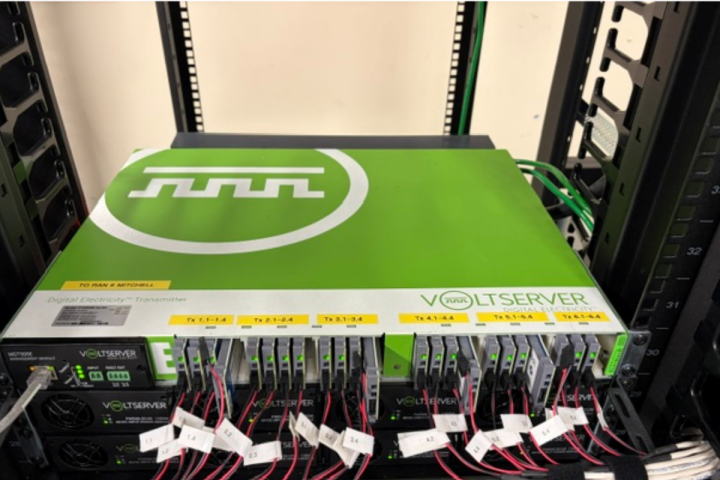
University IT (UIT) has completed Stanford's first VoltServer installation, a new approach to keeping outdoor cellular service available during extended power outages.
The challenge
Stanford's outdoor cellular coverage comes from Radio Access Networks (RANs) located across the main campus. A UIT strategic initiative aims to extend backup generator power to these RANs, keeping service online when the power goes out.
But not all buildings have generator power, including the Mitchell Earth Sciences Building and Ford Center, both of which house RANs. During an extended outage, that equipment would shut down—just when people might need cellular service most.
A new solution: VoltServer
Nearby Electronic Communications Hubs (ECHs) do have generator backup. But extending that power the traditional way would have required running new high-voltage wiring between the ECHs and the RANs, an approach involving significant trenching, permitting, cost, and disruption.
Instead, UIT turned to VoltServer, a technology that sends power over ordinary low-voltage cables rather than using heavy electrical wires. VoltServer converts standard power into a stream of safe, low-voltage pulses, sends them down the cable, and converts them back into usable power at the other end. No trenching is required, and it can carry power up to 1.2 miles.
Two VoltServer links now live
UIT installed two VoltServer links: “Press” ECH to RAN 6 in the Mitchell Earth Sciences Building, and “Near East” ECH to RAN 5 in the Ford Center. Now both of these sites have generator backup power through the extension of the new VoltServer links, so outdoor cellular service to the surrounding areas will remain available during an extended outage.
Why it matters
This project marks Stanford's first VoltServer installation of its kind and gives UIT a viable way to extend utility and generator backup power to sites it could not previously reach, without the cost and disruption of traditional wiring.
Thanks to UIT Mobile Infrastructure, Facility Engineering, IT Facilities Infrastructure & Resilience (IT FIRe), and the UIT Project Management Office for making this project a success.
Questions about the VoltServer implementation can be directed to the UIT Mobile Infrastructure team at iti-mobile-network-support@lists.stanford.edu.