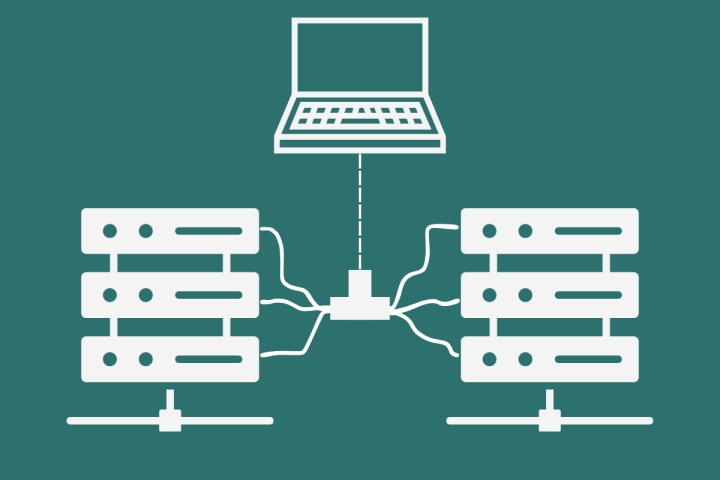
University IT’s Enterprise Technology (ET) team successfully migrated its on-premises virtual infrastructure from VMware to Proxmox. This migration establishes a more sustainable, flexible, and cost-effective foundation for the university’s enterprise computing services.
The migration and modernization
Previously, VMware supported Stanford’s enterprise administrative applications; however, after Broadcom acquired VMware, significant increases in licensing and support costs made the long-term model increasingly difficult to sustain.
This prompted ET to evaluate alternative platforms that could:
- Continue to meet enterprise needs
- Provide better cost predictability
- Align with modern infrastructure practices
Following careful evaluation and consultation with peer groups across campus and higher ed, ET selected Proxmox VE, an open-source virtualization platform built on the Debian Linux operating system and the open-source Kernel-based Virtual Machine (KVM) hypervisor.
Why Proxmox
Proxmox offers advanced features like virtualization, clustering, and high availability. Its primary virtualization engine, KVM, is well-established and was integrated into the Linux kernel in 2007.
KVM served as the core hypervisor (software that enables multiple operating systems to run on a single computer at the same time) for major cloud companies such as Google, giving the ET team confidence in its reliability.
On-premises virtualization remains essential for many enterprise systems where predictable cost and performance, integration with existing services, and compliance requirements are critical. Proxmox also supports API-driven infrastructure and automation, enabling better interaction with cloud services and support for our hybrid infrastructure.
Operational improvements
The migration led to several operational improvements:
- Migrated more than 60 server nodes into six independent Proxmox clusters.
- Transitioned approximately 1,500 virtual machines from the VMware environment using carefully planned migration workflows to minimize service disruption.
- Expanded automation across system build and ongoing operations, leading to a more standardized, repeatable, and operationally efficient platform.
- Established a sustainable and automation-enabled on-premises virtualization platform with Proxmox in production.
- Created a platform capable of evolving alongside the university’s longer-term enterprise computing needs.
Collaboration and execution
The ET Proxmox platform was completed in early 2025. The VMware to Proxmox migrations were scheduled throughout 2025, with the vast majority completed before winter break. This collaborative project involved ET infrastructure and Technical Services teams, with essential support from Hosting Services, Network Engineering, and the Project Management Office.
Contributing teams included:
- Project Sponsors: Ganesh Karkala, Armand Capote
- Enterprise Infrastructure Platforms: Lonlone Lee, Sanjay Pinto, Joseph Dick, Adam Lewenberg, Pablo Judd, Stanley Lee, Alan Ge
- Enterprise Linux Systems: Tony Chu, Emil Popov, Sanjib Goswami, Calvin Hom
- Enterprise Windows Infrastructure: Stanley Lui, Kanchan Mathur, Karen Tsai, Laurie Miller, Bharath Reddy Thummala Abbigari, Manthan Patel
- Authentication and Collaboration Systems: Srinivas Rao, Xueshan Feng, Rajib Basu, Richard Leung, Sriram Krovvidi
- Technical Services: Akshay Mathur, Anvesh Duddukuri, Badrinath Tripathy, Chris Heroux, Dilip Krishnamurthy, Ekanatha Pai, Jayant Mahishi, Jen Hong, Kumar Priyadarshi, Mary Mekala, Rajesh Mandalapu, Ramani Raman, Ramesh Manda, Robert Rodriguez, Sreenivas Konduru, Srikanth Govada, Varun Naib, Bhavana Tirukovalluri
- Project Management Office: Sushila Iyer
- Hosting Services: Ryan Quintos, Javier Reyes, Victor Reyes, Pablo Hernandez, Lucrecia Kim-Boswell
- Network Engineering: Drew Saunders, Will Johnson, Alvin Chew
- Land, Buildings & Real Estate: Blaine Chaffin